
Restaurant operators have spent a lot of time over the past several years thinking about value. They have had little choice. Food costs are higher. Labor costs are higher. Occupancy costs are higher. Consumers are paying more for just about everything, from groceries to gasoline.
As prices rise, however, something else happens. Expectations rise with them.
Consumers may understand that a restaurant cannot completely control what it pays for beef, labor or utilities. They are considerably less forgiving when they pay more and encounter indifferent service, an inaccurate order, a dirty dining room or food that simply is not very good.
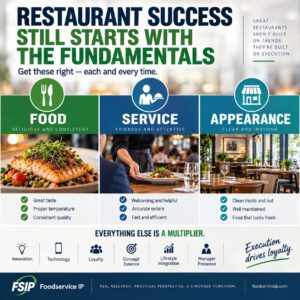
That is why I continue to come back to a very basic view of restaurant performance. Before all the other things we like to talk about in this industry, operators have to consistently deliver on three fundamentals — food, service and unit appearance.
Each and every time.
The Fundamentals Come First
There are plenty of important components to building a successful restaurant concept. Lifestyle integration matters. Concept essence matters. Technology matters. Menu innovation matters. Loyalty programs matter. Manager presence matters.
But these things work best as multipliers of a fundamentally sound operation. They have a much harder time rescuing one that cannot consistently execute.
A restaurant can have a great app and still serve a bad meal. It can have terrific branding and still have dirty tables. It can introduce an innovative menu item and then make customers wait 20 minutes for it.
The fundamentals are not particularly exciting. They are also difficult to execute consistently across hundreds or thousands of transactions.
That is precisely why they matter.
Consumers Have Long Memories for Bad Experiences
We saw a good example of this in Foodservice IP’s 2025 Convenience Store Foodservice study.
We asked 500 consumers what could prevent them from making a future visit for prepared food following an unsatisfactory initial experience. Taste led the list at 64 percent, followed by food temperature at 45 percent and speed of service at 40 percent. Nearly one-third cited order accuracy.
These aren’t futuristic attributes. There is no artificial intelligence, personalization or experiential branding involved. The consumer is essentially saying that the food needs to taste good, it needs to be served properly, and the transaction needs to work. Getting those things wrong can cost the operator the next visit.
Appearance sends a similar message. In the same research, 60 percent of consumers identified a clean store, including the inside, outside and restrooms, as something they look for when considering prepared food at a convenience store. More than half cited food that looks fresh.
Those findings came from convenience stores, but the larger lesson extends across foodservice. Customers constantly collect clues about an operation. The parking lot, restroom, counter, dining room, employees and appearance of the food all contribute to a judgment about whether an operation has its act together.
Service Has Become Part of the Value Equation
This becomes even more important as restaurant prices increase. Value is often discussed as though it were simply a price equation. Operators introduce bundles, discounts and limited-time offers to convince customers they are getting enough food for their money.
Price obviously matters. But value is also experiential.
A customer who pays $15 or $20 for a meal notices when nobody acknowledges them. They notice when employees seem inconvenienced by customers. They notice when an order is wrong, when the counter is dirty or when nobody appears to be in charge.
The opposite is true as well. A warm greeting, an employee who knows the menu, a correct order and a sincere thank you can change the perception of the entire transaction.
Interestingly, our convenience-store research found that c-stores held a 17-point net advantage over restaurants on speed of service. They also had a smaller advantage on value for the money. Restaurants should pay attention to that.
Convenience stores have historically tried to become more restaurant-like with better food, improved merchandising and more sophisticated foodservice programs. Restaurants probably don’t want to respond by becoming less convenient.
Consistency Is What Makes the Fundamentals Difficult
Almost every operator understands the importance of good food, good service and a clean restaurant. Knowing it isn’t the problem. Doing it every shift, at every location, with every customer is the problem.
That is where strong restaurant organizations separate themselves. Their fundamentals become systems rather than aspirations. Employees know what good service looks like. Managers know what they are expected to inspect. Food standards are clear. Problems are corrected before customers repeatedly experience them.
It isn’t glamorous work. It is also the work that allows everything else to matter.
Earn the Right to Add the Extras
The restaurant industry will continue chasing new opportunities. AI will become more important. Digital ordering will improve. Loyalty programs will become more sophisticated. Concepts will work harder to integrate themselves into consumers’ lifestyles.
They should. But those initiatives belong on top of a strong operating foundation, not underneath one. Food, service and unit appearance are the price of admission. They don’t guarantee that a restaurant concept will succeed. But consistently getting one of them wrong makes sustainable success considerably more difficult.
As consumers are asked to spend more when they dine away from home, that distinction becomes even more important.
Before asking what else the concept can add, operators might start with a much simpler question.
Are we getting the fundamentals right — each and every time?
Get practical foodservice intelligence delivered to your inbox. Our subscribers receive original research, industry analysis, blog updates, and announcements on new studies. Sign up to receive our communications.
Recent Comments