
Every season of The Bear reminds me why restaurants are one of the most fascinating—and misunderstood—businesses in America.
Yes, the show is dramatic. A season can compress months of operational headaches into a 20-minute episode. But beneath the anxiety and chaos is something remarkably accurate: restaurants are a constant balancing act between hospitality, operations, finance, and survival.
One of the themes I appreciate most is that the problems are rarely isolated. A plumbing issue becomes a cash flow problem. A reservation change becomes a labor problem. A delayed supplier payment affects tomorrow’s menu. Everything is connected.
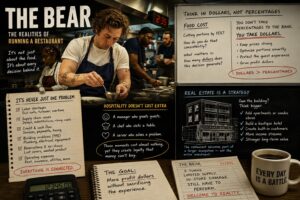
The financial discussions are particularly interesting because they highlight a mistake many operators make: thinking in percentages instead of dollars.
Food cost percentages matter, but percentages don’t get deposited into your bank account.
Consider the common suggestion to “reduce portions by 15%.” That sounds simple in a spreadsheet. In reality, how does a chef consistently remove exactly 15% from every plate without affecting presentation, guest satisfaction, or consistency? Most can’t.
A better question is: How many dollars does this decision actually generate?
Keeping menu prices stable while thoughtfully optimizing portions can improve profitability—but only if guests continue to perceive value. The goal isn’t simply lowering food cost percentages. The goal is generating more profit dollars while protecting the dining experience.
The show also reminds us that hospitality isn’t always expensive.
A manager who genuinely greets guests. A chef who visits a table. A server who solves a problem before it becomes a complaint. Those moments cost almost nothing, yet they often create more loyalty than another dollar spent on advertising or promotions.
That’s a lesson many operators overlook.
Another aspect The Bear hints at—but doesn’t fully explore—is the importance of the real estate itself.
For many independent restaurants, the building may ultimately become the more valuable asset than the restaurant. Mixed-use concepts—adding apartments, condos, offices, or boutique hotel rooms above the restaurant—can create built-in customers while diversifying income. Those residents become regulars for breakfast, lunch, takeout, late-night sandwiches, or, in the show’s case, the famous beef window.
The restaurant becomes part of a larger economic ecosystem rather than carrying the entire investment on its own.
Perhaps that’s the biggest takeaway from The Bear. Running a restaurant isn’t about finding one magical cost to cut. It’s about making hundreds of interconnected decisions every week involving labor, purchasing, maintenance, pricing, reservations, cash flow, guest experience, and long-term investment.
Restaurants rarely produce spectacular profit margins. Unless they become scalable through franchising or expansion, they are often difficult financial investments.
But they do generate something different: movement. Cash flows. Relationships. Community. Energy.
The Bear captures that reality remarkably well. Beneath the shouting and the drama is a simple truth every operator understands: success doesn’t come from obsessing over percentages. It comes from making better decisions that create real dollars while giving guests a reason to come back tomorrow.
Get practical foodservice intelligence delivered to your inbox. Our subscribers receive original research, industry analysis, blog updates, and announcements on new studies. Sign up to receive our communications.
Recent Comments