
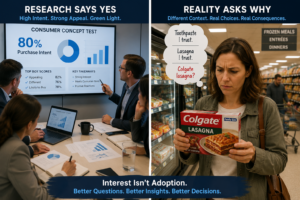
Every few years, a list of the “worst product launches of all time” circulates online. The usual suspects appear: Colgate frozen lasagna, Pepsi AM, Cosmopolitan yogurt, and Life Savers Soda.
These products are often remembered as examples of poor judgment. Yet they raise a more interesting question: how did these ideas make it through the planning process in the first place?
The answer may have less to do with bad products and more to do with how companies gather, interpret, and act on information.
The Problem Isn’t Always the Research
Many people assume these products were launched without consumer research. In reality, large manufacturers have been conducting research for decades through surveys, focus groups, concept testing, telephone interviews, and test markets. The challenge is that research is only as valuable as the questions being asked.
Consider a hypothetical question: “Would you be interested in a convenient breakfast beverage with more caffeine?” Many consumers might answer yes. Now consider a different question: “What is your reaction to drinking cola instead of coffee at breakfast?” The second question uncovers perceptions, concerns, and barriers. The first simply measures interest.
Both questions have value, but they produce very different insights. One explores curiosity. The other explores behavior.
The Difference Between Interest and Adoption
One of the most common mistakes in innovation is confusing curiosity with commitment. Consumers often express interest in new ideas. That does not mean they will purchase them repeatedly, recommend them to others, or make room for them in their routines.
Consider Life Savers Soda. Consumers loved Life Savers candy and were familiar with the brand’s flavors. On paper, extending the brand into beverages may have appeared logical. Yet many consumers found the product overwhelmingly sweet and struggled to finish a full serving. The concept generated interest, but interest did not translate into sustained demand.
The same principle likely applied to Colgate frozen meals. Consumers may have trusted the Colgate brand, but trust in toothpaste does not automatically translate into credibility in frozen foods. Consumers organize brands into mental categories, and Colgate belonged in the bathroom, not the freezer aisle.
Interestingly, other companies have recognized this challenge and managed it successfully. Years ago, I worked with Clorox on both Hidden Valley Ranch and Cattlemen’s BBQ Sauce. Most consumers never associated those products with Clorox because the company wisely maintained distinct brand identities. Consumers were happy to buy ranch dressing and barbecue sauce. They simply did not need to see the Clorox name on the label. Understanding the difference between corporate ownership and consumer-facing branding can be just as important as understanding the product itself.
Research Is Not a Vote
One of the biggest misconceptions about market research is that its purpose is to ask consumers whether an idea should move forward. Research is not a vote.
Consumers are not product managers. They are not responsible for manufacturing, distribution, menu integration, pricing, or profitability. Their role is to provide insight into perceptions, behaviors, needs, and barriers.
The most valuable research often comes from questions that challenge an idea rather than support it. What seems confusing? What problem does this solve? What would prevent you from trying it? What existing product would it replace?
These questions frequently reveal risks that purchase-intent scores alone cannot identify.
Why Qualitative Research Still Matters
While surveys help quantify demand, qualitative research often reveals the issues that surveys miss. A focus group participant who laughs and says, “Why would I buy dinner from a toothpaste company?” may provide more strategic value than dozens of favorable purchase-intent scores.
At Foodservice IP, we see a similar dynamic in operator research. A survey may indicate strong interest in a new product concept, while an operator interview reveals a critical obstacle: “I don’t have freezer space.” That single comment can completely change the opportunity assessment.
This is why qualitative and quantitative research work best together. Qualitative research helps uncover motivations, barriers, and language. Quantitative research helps determine how widespread those findings are. Neither should be viewed as a substitute for the other.
The Goal Is Better Decisions
Research should not be used to validate a decision that has already been made. Its purpose is to identify risk, challenge assumptions, and improve outcomes.
The most valuable studies are not those that tell clients what they want to hear. They are the studies that reveal what they need to know before making a significant investment. Sometimes research supports a launch. Sometimes it suggests modifications. Occasionally, it provides the evidence needed for a no-go decision.
In many cases, that may be the most valuable finding of all.
The lesson from Colgate lasagna is not that companies occasionally make bad decisions. It is that successful innovation depends on asking the right questions, selecting the right methods, and remaining willing to follow the evidence wherever it leads.
Like our content? Subscribe.
Recent Comments