
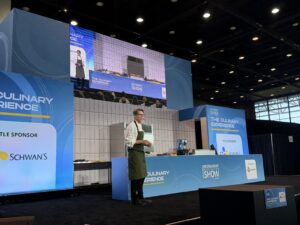
After attending the National Restaurant Association Show for more than two decades, I’ve realized the event itself becomes part sociology experiment, part endurance sport, and part business intelligence gathering exercise. The cycle rarely changes.
People fly into Chicago optimistic and overdressed. The first two nights involve too much steak, too many cocktails, and somebody insisting the group needs to “hit one more place” on Rush Street like it’s still 1985. By Sunday morning, half the industry is puffy-eyed, dehydrated, and quietly hunting for free probiotic drinks, electrolyte packets, cold brew, or functional wellness shots before dragging themselves onto the show floor.
Then comes the walking. Endless walking. Fourteen miles a day under fluorescent lighting while trying to casually glance at badges to determine whether someone is a mark. As someone wearing a “consultant” badge myself, I’ve become very familiar with the subtle look of disappointment people give when they realize you are not a prospect but the dreaded information gatherer.
But underneath all the spectacle, the show still reveals where the industry is actually heading.
And honestly, the floor itself tells the story. One minute you’re watching celebrity chefs under giant corporate-sponsored culinary stages. The next minute you’re staring at a gold-wrapped Liquid Death hearse parked next to a functional tea display while someone explains how AI can optimize your sauce inventory. A few aisles later, you’re standing in front of pork rinds the size of couch cushions wondering whether protein snacking has officially replaced meals altogether.
That’s the NRA Show in 2026.
Here were my five biggest takeaways.
1 – AI Is Everywhere — But People Are Already Tired of Hearing About It
In case you’ve been trapped in a well or a coma the last few years, artificial intelligence is apparently becoming mildly popular.
AI dominated the show floor to an almost comical degree. Voice AI. Predictive AI. AI assistants. AI-driven inventory systems. AI-generated menu optimization. Some booths practically acted as if artificial intelligence was going to butter breadsticks and refill beverages by itself. But underneath the enthusiasm was skepticism.
Operators are no longer interested in technology that sounds futuristic but creates more complexity. The strongest conversations focused on practical applications — labor forecasting, inventory visibility, ordering simplification, and operational decision support. Restaurant operators already wear too many hats. They want fewer headaches, not more dashboards.
And nearly every booth tied its messaging back to the same phrases: “solutions,” “labor savings,” and “operational efficiency.” The industry clearly still feels pressure around labor and margin management.
2 – Robotics and Automation Are Becoming More Serious
Robots have been at the show for years, but the conversations around them felt more grounded this time. Kitchen automation, fry stations, repetitive prep functions, and even drone delivery are increasingly viewed through the lens of labor economics rather than novelty. Most operators still believe costs need to come down before robotics become mainstream, but the direction is obvious.
Interestingly, equipment exhibitors seemed especially busy this year. Tableware, back-of-house systems, and operational equipment booths appeared to have strong engagement throughout the show. Whether that signals confidence, deferred replacement spending finally returning, or cautious reinvestment after several difficult years remains to be seen — but the energy felt healthier than expected.
3 – Functional Snacking and Protein Continue to Expand
The food trends themselves reflected where consumers are emotionally right now — comfort combined with health signaling. Protein-enhanced foods were everywhere. Functional beverages were everywhere. Sauces, global flavors, spicy condiments, probiotics, little treats, breads, fusion drinks, and snackable indulgences dominated the floor.
Interestingly, plant-based alternatives no longer dominated conversations the way they did several years ago. Consumers still want indulgence. They just increasingly want it wrapped in the language of wellness, protein, texture, energy, or gut health. The giant pork rind displays somehow perfectly captured the mood of the entire show — indulgent, absurd, snackable, and somehow still marketed as protein optimization.
4 – Simplicity and Execution Are Quietly Making a Comeback
One of the most important undercurrents at the show was operational simplification. After years of bloated menus, endless LTOs, fragmented delivery systems, and overloaded tech stacks, many operators appear to be rediscovering the value of focus. Several of the most credible presentations centered around execution, hospitality, consistency, and profitable growth rather than disruption for disruption’s sake.
In many ways, the industry seems exhausted from chasing every shiny object. That said, sustainability messaging remained strong. Compostable packaging, waste reduction, and environmentally friendly materials were heavily promoted throughout the floor, though increasingly positioned through operational practicality rather than pure virtue signaling.
5 – Growth Looks Different Than It Did Ten Years Ago
The definition of growth has changed. The smartest operators are no longer simply chasing unit counts. They are looking at format flexibility, off-premise optimization, traffic stability, operational efficiency, and how to fit into changing consumer routines. That matters because the consumer environment remains deeply fragmented. Some consumers are aggressively trading down while others continue spending freely on experience and convenience. The winners will be the brands capable of navigating both realities at once.
There were also subtle signs the industry may be regaining some confidence. Sunday traffic reportedly rebounded significantly after a lighter Saturday, international exhibitors appeared more present, and there was solid engagement across many categories. Even the pickleball courts hidden deep in the North Hall somehow felt symbolic — a reminder that foodservice increasingly intersects with lifestyle, entertainment, branding, and social identity.
And perhaps that’s the biggest lesson from this year’s show. Beneath all the AI demos, probiotic sodas, drones, wearable tech, cocktail receptions, celebrity chefs, and branded swag, the industry still comes back to the same core challenge:
How do you operate smarter while staying relevant to consumers whose habits continue changing faster than ever?
At Foodservice IP, we spend our time helping manufacturers, operators, and suppliers answer exactly those questions. As the leading independent full-service foodservice consultancy, we combine primary research, strategic analysis, and practical industry expertise to help clients see where the market is truly moving — beyond the hype and into actionable growth strategy.
Tim Powell is a Principal with Foodservice IP. To learn more about FSIP’s Management Consulting Practice, click here.
Like the content? Sign up to receive our communications.
Recent Comments