
For the better part of the last two years, the industry narrative has been simple. The consumer is under pressure.
Wages are up, but so are prices. Gas fluctuates. Interest rates remain elevated. Confidence dips, rebounds, then softens again. The conclusion is usually the same—consumers are pulling back, and foodservice is feeling it.
But that framing misses something important.
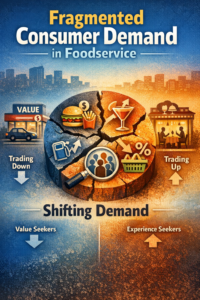
The consumer isn’t behaving as one group. And increasingly, neither is demand.
Pressure Exists—But It’s Uneven
At a macro level, the signals are mixed. Wage growth has outpaced prior years, but much of that gain has been absorbed by higher costs across essentials. Gas, in particular, continues to act as a kind of behavioral tax—small swings that disproportionately impact how consumers feel, not just what they spend.
At the same time, employment remains relatively stable, and certain segments of consumers—particularly higher-income households—are still spending.
The result is not a uniform pullback. It’s fragmentation.
Some consumers are trading down, looking for value, pulling back on frequency. Others are holding steady—or even trading up selectively, choosing where an experience still feels worth it.
Foodservice Is Splitting Along Those Lines
This uneven pressure is showing up clearly across foodservice.
Quick-service and value-oriented formats are seeing continued traffic, but often with margin pressure as discounting and promotions do more of the work. At the same time, premium fast casual and certain experiential dining occasions continue to hold—less frequent, perhaps, but still prioritized.
Even within a single concept, behavior is shifting. Consumers may visit less often, but spend more when they do. Or they may shift dayparts, channels, or order composition to manage spend.
This is not a demand problem in the traditional sense. It’s a demand redistribution.
The Risk of a One-Size-Fits-All Strategy
For manufacturers, the implication is straightforward—but often overlooked.
A generalized “value” message is not enough. In some cases, it may even erode positioning where consumers are still willing to pay for quality, differentiation, or experience.
At the same time, ignoring value entirely misses where real pressure exists—particularly in high-frequency, price-sensitive occasions.
The challenge is not choosing between value and premium. It’s understanding where each applies—and to whom.
What This Means Going Forward
The next phase of foodservice growth will not be driven by broad recovery. It will be driven by precision.
Where is the consumer actually feeling pressure—and where are they not? Which occasions are being cut, and which are being protected? Where does price matter most, and where does it fade behind convenience, quality, or experience?
These are not academic questions. They shape product design, packaging, pricing strategy, and how manufacturers show up with operators.
Because the consumer is still spending. Just not evenly.
To learn more about FSIP’s Management Consulting Practice, click here.
Like the content? Sign up to receive our communications.
Recent Comments