
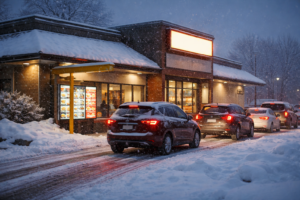
Large portions of the country are again under winter storm advisories. Snow, ice, school closures, delayed deliveries, and staffing disruptions are becoming routine rather than exceptional. For foodservice, these events are not simply weather stories. They are operational stress tests that reveal where systems are resilient — and where they remain fragile.
Weather is one of the few forces that touches the entire value chain at once. It alters consumer behavior, constrains labor, disrupts logistics, and forces rapid menu and execution decisions. For manufacturers, storms provide unusually clear insight into how operators actually behave when conditions deteriorate.
Demand Doesn’t Disappear — It Reallocates
Severe weather rarely eliminates demand. It reshapes it. On-premise traffic softens while drive-thru, delivery, and grab-and-go accelerate. Breakfast often collapses as commutes disappear, while late lunch and early dinner consolidate. Consumers gravitate toward comfort, familiarity, and perceived value.
Velocity concentrates quickly into a smaller set of menu items and formats. Operators with flexible menus and adaptable prep models capture this demand. Those locked into rigid execution models tend to lose it.
For manufacturers, this is revealing. Products that perform best share common traits: speed, consistency, and broad appeal. Frozen, par-baked, thaw-and-serve, and fully cooked formats consistently outperform labor-intensive scratch items when conditions tighten.
Labor Becomes the Binding Constraint
Storms first show up in staffing. Absenteeism rises. Commutes lengthen. Childcare disruptions ripple through schedules. Experience levels compress. Kitchens simplify. In healthcare, senior living, K-12, and commissaries, coverage becomes the priority overnight. Menus narrow. SKUs shrink. Execution tolerance declines.
Under pressure, operators gravitate toward products that reduce complexity: pre-prepped proteins, fully cooked grains, sauces, and breakfast components that can be executed consistently with fewer hands and less training.
Brands that position around reliability rather than novelty often gain share in these moments — and retain it long after.
Supply Chains Reveal Their Weak Points
Winter exposes fragility faster than any quarterly review. Trucking delays, missed windows, plant slowdowns, and distributor cutoffs surface quickly. Regional production footprints, frozen inventories, multi-DC redundancy, and substitution flexibility suddenly become strategic assets rather than cost considerations.
Manufacturers that communicate clearly, flex allocations, and offer practical alternatives earn trust that extends well beyond the event itself. In our experience, operators remember who helped them stay open.
Menu Strategy Becomes Risk Management
Extreme weather forces rapid prioritization. Limited-time offers pause. Complex builds disappear. Core sellers dominate. Items that travel well and tolerate longer holds gain share. Portions tighten. Bundles and family meals outperform premium experimentation.
Innovation yields temporarily to continuity. For manufacturers, these moments clarify positioning. Are your products essential to throughput and consistency — or optional when the system is stressed?
The Consumer Mindset Favors Comfort and Value
Consumer behavior in storms is remarkably consistent. Guests seek warmth, familiarity, and reassurance. Hot beverages, sandwiches, soups, pizza, breakfast platforms, and indulgent bakery benefit disproportionately. Price sensitivity rises, trips consolidate, and households favor dependable choices over experimentation.
The operators that win are not necessarily the most creative. They are the most dependable.
What This Means for Manufacturers
Storms are no longer anomalies. They are recurring tests of strategy. The most important questions are structural:
- Which products help operators simplify when labor is constrained?
- Which formats protect throughput and consistency under stress?
- Where are logistics and sourcing most exposed?
- Are we positioned as a continuity partner or a discretionary supplier?
Extreme weather compresses years of operational learning into days. The manufacturers that emerge stronger are not simply those with the most innovation in market. They are the ones whose portfolios, supply chains, and execution models are built for volatility.
Storms, in that sense, are not interruptions to strategy. They are strategy — revealed.
By Tim Powell, Managing Principal, Foodservice IP
To learn more about FSIP’s Management Consulting Practice, click here.
Like the content? Sign up to receive our communications.
Recent Comments