
You’ve probably heard the phrase “K-shaped recovery” tossed around in economic commentary. It’s often referenced with a knowing nod, rarely explained, and even more rarely applied in a way that’s useful for foodservice decision-makers.
So let’s define it plainly—and then talk about why it matters.
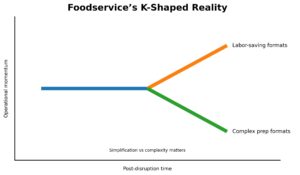
A K-shaped recovery describes what happens after a disruption when different parts of the economy move in opposite directions at the same time. One group improves—growing sales, margins, and resilience—while another struggles or declines. Instead of rising together, outcomes split. Visually, it looks like the two arms of the letter “K.”
In foodservice, this isn’t a theory. It’s the operating reality.
Foodservice didn’t “recover”—it diverged
In the early days of the pandemic, most conversations assumed foodservice would rebound collectively once dining rooms reopened and traffic returned. But several years later, it’s clear that recovery didn’t bring convergence. It brought separation.
Some operators emerged stronger:
-
Scaled QSRs with pricing power and streamlined menus
-
Convenience stores that invested early in foodservice
-
Institutional segments with predictable demand and contractual volume
Others never fully regained their footing:
-
Independents without systems or labor flexibility
-
Mid-tier casual dining squeezed by food, labor, and rent inflation
-
Formats built around traffic patterns that no longer exist
Same macro environment. Very different outcomes.
That divergence is the essence of the K-shape.
The K-shape isn’t just about operators
Where this becomes especially important for manufacturers is that the K-shape runs through the entire foodservice ecosystem—not just at the restaurant level.
Channels are diverging.
Some are consolidating, investing, and professionalizing. Others are shrinking or becoming opportunistic buyers.
Manufacturers are diverging.
Those with multi-channel exposure, labor-saving formats, and distributor-friendly economics are finding paths to growth. Others—often equally innovative on paper—are constrained by formats that require too much operator effort, training, or menu disruption.
Even within the same chain, the K-shape appears by:
-
Daypart
-
Geography
-
Menu role (core vs optional items)
The result is a market where planning for the “average operator” is increasingly misleading.
Why this matters now
The K-shaped reality has become more visible because recent pressures—labor costs, inflation, interest rates—don’t hit everyone evenly. They reward structural advantages like scale, simplicity, and systemization, while exposing fragility in business models that relied on abundance and flexibility.
For manufacturers, this changes the strategic questions that matter:
-
Which operators still have discretion to test, add, or trade up?
-
Which channels are building for the future versus managing decline?
-
Which products fit today’s operational constraints—not yesterday’s ideals?
Growth doesn’t come from being “relevant to everyone.” It comes from being essential to the right side of the K.
The FSIP takeaway
Foodservice isn’t rebounding unevenly—it’s reorganizing unevenly. That’s why segmentation, channel prioritization, and operator-grounded insight matter more today than they did pre-2020.
The opportunity isn’t to chase recovery narratives. It’s to understand where structural momentum exists—and where it doesn’t—and build accordingly.
To learn more about FSIP’s Management Consulting Practice, click here.
Like the content? Sign up to receive our communications.
Recent Comments